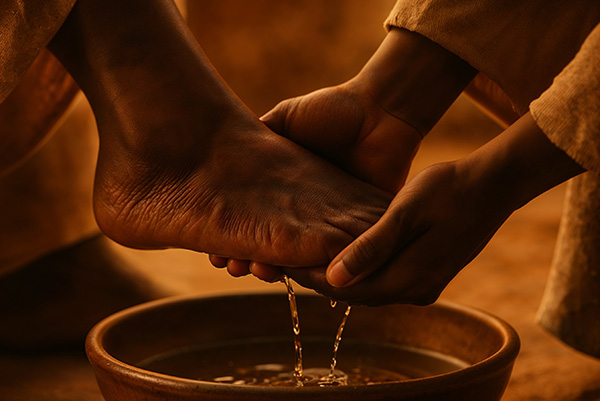
I’ve always found the idea of ritual footwashing both beautiful and, if I’m being honest, a little terrifying.
This is the time of year that footwashing is in the news, as the Pope washes feet in a service echoing the story of Jesus washing his disciples’ feet at the Last Supper.
A few centuries ago, bishops and monarchs, including Queen Elizabeth I, would hold ceremonies to wash feet. It was public display of humility and service.
Recently, more Christian denominations have brought the ritual back in an effort to “embody” the liturgy by enacting the stories and symbols of humility, service, love, connection.
Footwashing sounds fine, especially for people long ago who traveled dusty roads on foot.
But now? And me? Letting someone kneel and wash my bare, imperfect feet?
It stirs something more than modesty. Maybe it’s pride. Maybe it just seems weird.
And maybe it’s something more unsettling, like vulnerability…
A recognition that I am mortal, and the day will come when someone else will wash my feet because I no longer can.
That kind of vulnerability is something none of us seems eager to embrace.
And yet here we are, on Maundy Thursday, and I keep thinking about this odd and tender ritual.
Somehow it gets to the heart of something I haven’t quite been able to name until now: the challenge – and the gift – of honoring the body.
Not just the idea of a body, or a stylized icon of it. But real bodies. Lived-in bodies. Bodies that ache and age and break down. Bodies that are not always clean or graceful or easy to look at.
Bodies like ours.
Bodies like those of the people we love when they are dying.
As many of us learn too late, death is a profoundly physical experience. In the final days and hours of a person’s life, care shifts from curing to comforting.
In that space, there are many ways to honor the dying body of a loved one:
- Preparing food they can still enjoy, even in small bites
- Moistening their lips when they no longer want to eat or drink
- Gently rubbing lotion into dry hands or feet
- Brushing hair, adjusting pillows, tucking warm blankets around them
- Singing or playing their favorite songs.
- Sitting in silence, simply offering presence.
None of these are heroic acts in the usual sense. They are the last ways we get to say, “You matter.” “You’re still here.” “You are loved.”
In her beautiful book, Honoring the Body, Stephanie Paulsell writes about a friend helping her dying mother enjoy a tub bath one last time. It was an act of devotion – no big ceremony.
Just a bath like so many her mother had given her as a child, and like her mother had enjoyed giving to herself, but no longer could. A simple tub bath was one last tender blessing she could offer her mother.
Throughout history, humans have found ways to honor the body even after death — washing it, clothing it, sitting with it and keeping vigil, gathering to remember the life that has ended.
There’s a shared understanding in all these practices that the body, even in death, deserves care and respect.
But maybe the deeper invitation is this:
What if we didn’t wait until death to honor our bodies?
What if we treated our physical selves with the same tenderness we offer to others at the end of life? Not in a self-care-as-consumerism way, but in a respectful, honest way:
- What if we listened when our bodies asked for rest?
- What if we moved them not just to “work out,” but simply to enjoy them?
- What if we fed them with love, touched them with kindness, and forgave them for not being perfect?
And what if we honored the bodies of others, across all kinds of differences?
The tired bodies of caregivers. Grieving bodies of widows and widowers.
Aging bodies of those who feel invisible in our youth-obsessed culture.
Disabled bodies that carry wisdom in every scar and adaptation.
Dying bodies, teaching us how to let go.
Maybe the vulnerability of footwashing isn’t just about discomfort. Or maybe it is – but the good kind.
The kind that strips away our excess armor and helps us remember what it means to be human, how it feels to serve and be served.
And how it feels to let our imperfect bodies hear this message: You are worthy of care.
That feels life-giving to me.